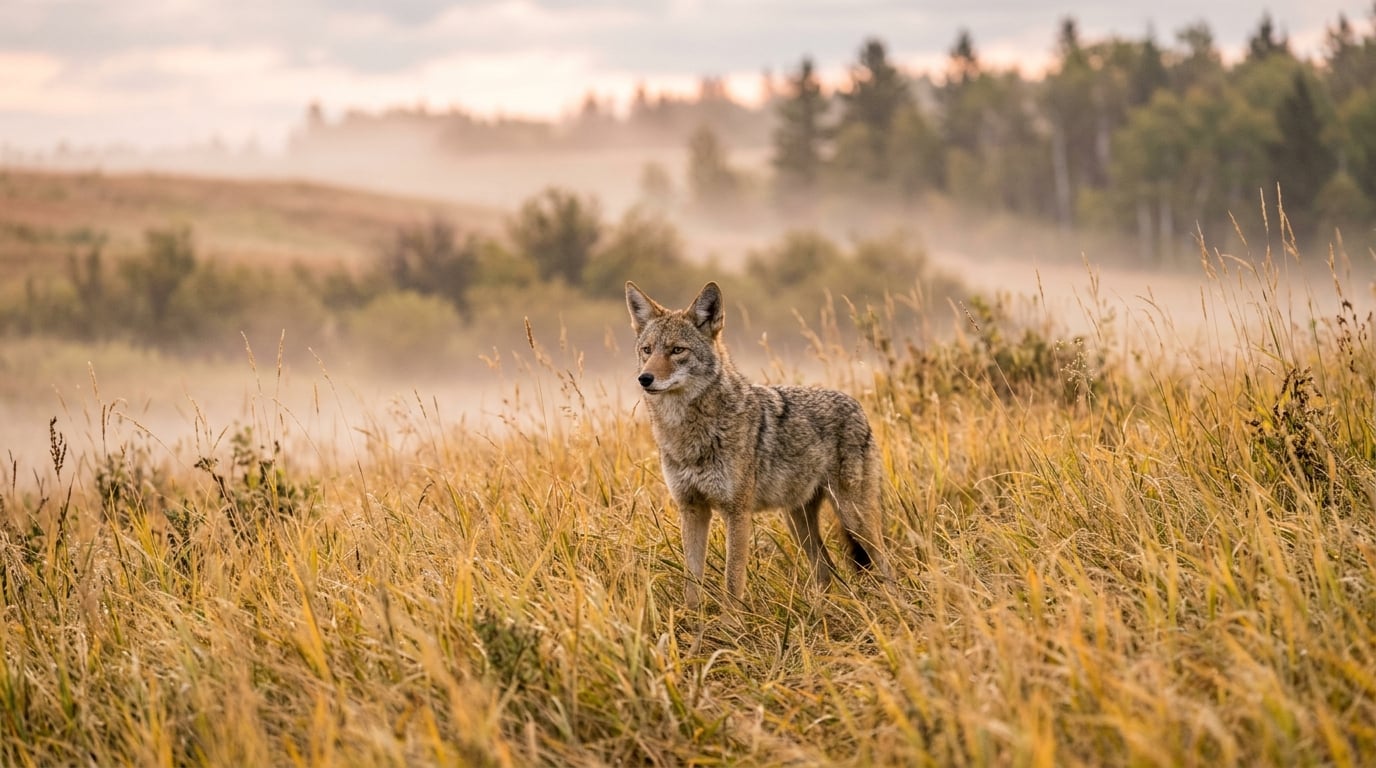
Coyote sightings at Calgary off-leash parks are common enough that most regulars have a story, and the City of Calgary tracks and responds to them as a routine part of managing urban parks, not a rare emergency.
Here's what actually works if you encounter one, and which parks see the most activity.
Which Calgary Dog Parks Have the Most Coyote Activity?
Nose Hill Park has one of the higher coyote populations of any Calgary park, largely because its scale and prairie terrain support a healthy prey base of ground squirrels and small mammals.
Fish Creek Provincial Park and Edworthy Off-Leash Dog Park also see regular coyote activity, both large natural-area parks bordering river valleys that coyotes use as travel corridors.
Fenced parks like Sue Higgins Park see far fewer encounters, since the perimeter fence and higher foot traffic naturally discourage coyotes from approaching, though it's not a total guarantee, particularly along wooded edges.
What Time of Day Are Coyotes Most Active?
Dawn and dusk are the highest-risk windows, when coyotes are naturally most active hunting small prey.
During denning season, roughly February through June, coyotes can also behave more territorially and may be seen more often during the day as they defend territory near a den site.
What Should I Actually Do if I See a Coyote?
Do not run, and do not turn your back on it. Both trigger a chase instinct in most canids, coyotes included.
Maintain eye contact and back away slowly, creating distance without turning your body away from the animal.
Make yourself look bigger: raise your arms overhead, and yell in a loud, confident voice. Most coyotes will retreat the moment they register you as a real threat rather than an easy target.
If it doesn't retreat, throwing rocks or sticks in its direction, or using a walking stick to appear larger, are both reasonable next steps recommended by wildlife officials.
What Should I Do With My Dog Specifically?
Recall your dog immediately and leash up. This is the single most important action, and it matters more than anything you do yourself.
Keep your dog physically close and between you and any exit route rather than letting them investigate the coyote, even out of curiosity rather than aggression.
Small dogs are at meaningfully higher risk than large dogs, so if you have a small breed, consider carrying them rather than walking them past a coyote at ground level.
Are Calgary Coyotes Actually Dangerous to Dogs?
They can be, though direct attacks remain uncommon relative to how often sightings happen. Coyotes have, on a small number of occasions, harassed or attacked dogs in Calgary parks, usually smaller dogs encountered without an owner nearby to intervene.
A widely reported 2018 incident at Parkdale's off-leash park, where a coyote ran directly toward two leashed dogs before their owner could react, is a useful real example: the dogs were fine specifically because they were already leashed and kept at a safe distance when it happened.
Fish Creek Provincial Park itself has direct history here: in 2022, a portion of the park was temporarily closed after two aggressive coyotes attacked a man and his dog on a trail. The owner fended the coyotes off using a stick, a real-world case that backs up the "throw rocks or sticks, make yourself look bigger" advice above rather than just theory. Conservation officers noted coyotes can view other dogs specifically as territorial threats, not just as potential prey.
More recently, in July 2025, a Calgary woman and her dog were bitten by a pair of coyotes while walking the bike path through West Confederation Park, part of what local coverage described as a climbing number of reported encounters that year. Small dogs face the highest stakes: a Valleyview Park incident in southeast Calgary ended with a small dog carried off by a coyote after its owner briefly lost sight of it in tall grass at dusk, exactly the scenario the "keep small dogs close, consider carrying them" guidance above is meant to prevent.
Most encounters are closer to tense standoffs than actual attacks, and the City of Calgary's response to problem coyotes uses non-lethal "hazing" techniques (loud noises and unpleasant-but-harmless deterrents) specifically to keep coyotes wary of humans rather than escalating toward removal. In rare cases involving a single animal responsible for multiple attacks on people, as happened in northwest Calgary in 2021, the City has authorized targeted removal of that specific animal rather than broader culling.
Should I Report a Coyote Sighting?
Yes, for non-emergency sightings, call 311 or report online through the City of Calgary. This helps Calgary Parks track activity patterns and post warning signage at specific parks when needed.
For an active, aggressive encounter posing immediate danger, call 911 instead of 311.
You can also reach Alberta Fish & Wildlife directly at 403-297-6423 to report a sighting or a specific concern outside city jurisdiction.
Does Leashing My Dog in an Off-Leash Area Ever Make Sense?
Yes, and Calgary's own official guidance says as much: keeping your dog on a leash "at all times, even in a designated off-leash area" is one of the recommended ways to reduce coyote conflict risk, particularly during denning season or in parks with recent sightings.
This isn't a contradiction of off-leash park rules, since you're always required to carry a leash in a designated area anyway; using it during a known higher-risk window is simply good judgement, not a bylaw issue.
What About Other Wildlife at Calgary Dog Parks?
Porcupines are the other recurring hazard, especially in wooded pockets at parks like Nose Hill and Fish Creek. Porcupines don't shoot quills, but a curious dog that gets too close ends up quilled regardless, which almost always means an emergency vet visit to remove them safely.
Deer are common at dawn and dusk in the same large natural-area parks where coyotes are most active, and while deer aren't typically aggressive, a startled deer can injure a dog that chases it, and it's illegal under Calgary bylaw for a dog to harass wildlife regardless of the species.
For the complete official picture, Calgary's urban coyotes page covers the City's conflict-response approach in more detail, and our off-leash guide covers the general voice-and-sight-control standard that keeps a coyote encounter from turning into something worse.
Should I Carry Anything Specifically for Coyote Encounters?
Not really anything specialized. A whistle or a small air horn can help you appear larger and more threatening from a distance if yelling alone doesn't work, and some owners carry one specifically for this reason on regular visits to higher-activity parks like Nose Hill.
The genuinely useful gear is what you'd already want for off-leash visits generally: a leash you can get onto your dog quickly, since fumbling for it during an actual encounter wastes the seconds that matter most.
Is It Safe to Visit a Park After a Recent Coyote Sighting?
Generally yes, with adjusted expectations. A single reported sighting doesn't mean a park should be avoided entirely, since coyotes are present in most of Calgary's larger natural-area parks as a matter of course, not as an unusual event.
What it should change is your approach for that visit: stick closer to your dog than usual, avoid dawn and dusk timing if you can shift your visit, and keep the leash within easy reach rather than stowed away. Posted signage at a park entrance about recent activity is worth reading and taking seriously rather than ignoring.
Do Coyote Sightings Follow a Seasonal Pattern in Calgary?
Yes. Sightings and reported encounters tend to climb heading into spring as denning season begins, typically peaking through the spring and into early summer while coyotes are raising pups and more actively defending territory.
Activity doesn't disappear the rest of the year, but the late winter through early summer stretch is when most parks see the increase in reports that sometimes prompts the City to post additional warning signage.