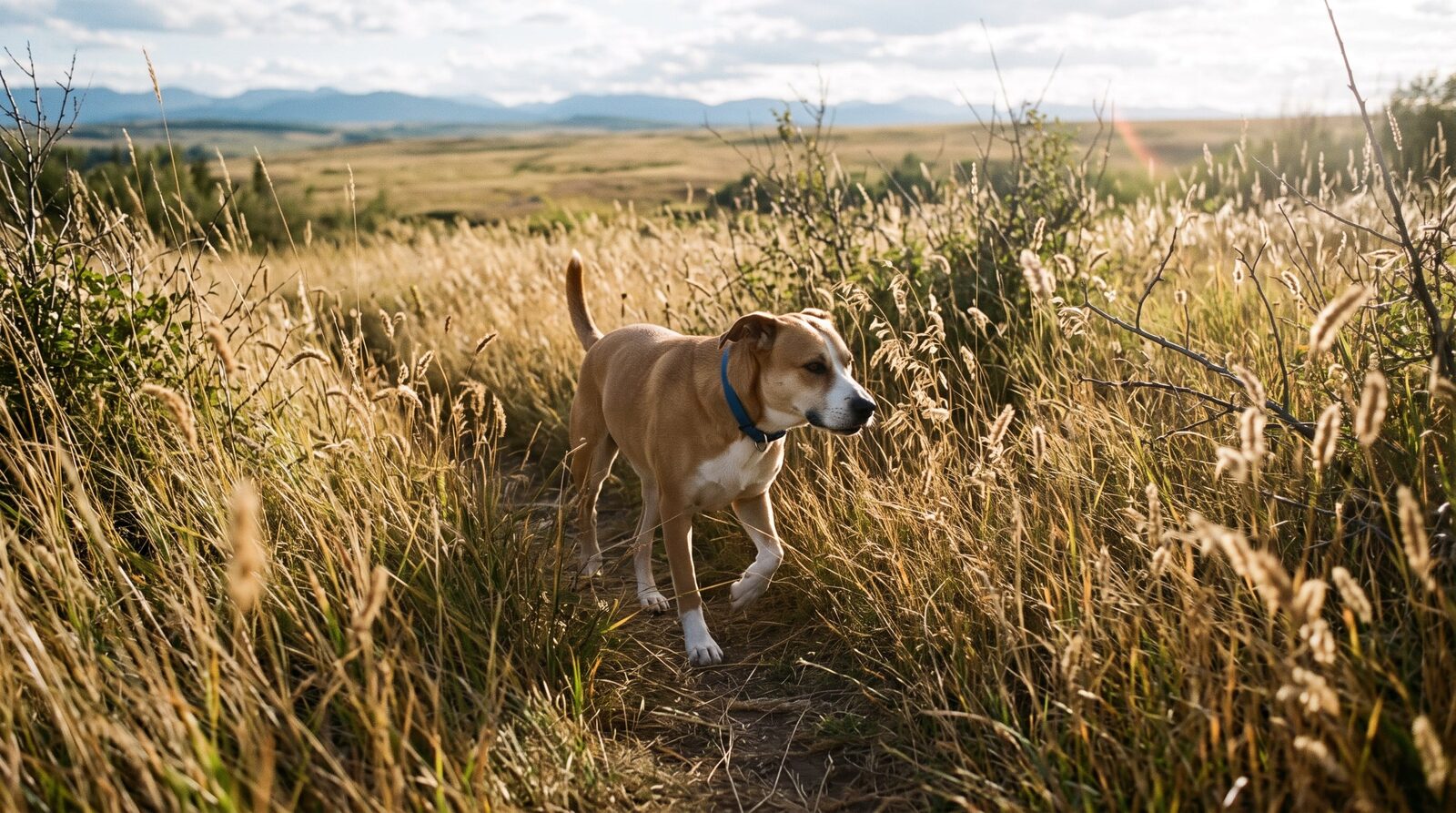
Foxtails, ticks, and porcupines are three unrelated hazards that all peak at Calgary parks during the same stretch of the year, roughly spring through fall. Here's what to actually watch for with each.
Foxtails and Grass Awns
Foxtail grass and similar barbed seed heads (bromegrass, cheatgrass, wild barley are all common culprits in Alberta) grow through spring and summer, drying and hardening by mid-to-late summer into sharp, barbed seeds that hook forward into anything they touch and can't easily back out.
What Are the Signs of a Foxtail Injury?
What Do I Do if I Find a Foxtail on My Dog?
If it's visible and not yet deeply embedded, remove it carefully with tweezers, pulling in the same direction it entered rather than sideways. If it's embedded, causing visible pain, or you can't fully remove it, get to a vet promptly rather than trying to dig for it, since the barbed shape means a partial removal can leave a piece that keeps migrating inward.
An awn inhaled or lodged near the eye, ear, or deep in the nose needs a vet regardless of how it looks on the surface, since these can migrate toward internal tissue and, in rare cases, the lungs.
How Do I Prevent Foxtail Injuries?
Stick to maintained trails rather than pushing through tall, unmowed grass, particularly from July through September when awns are fully dried and at their sharpest. Check your dog's paws, ears, coat, and face after any walk through longer grass, running a hand or comb through the coat specifically looking for anything barbed. Long-haired and heavily-coated breeds need more thorough checks than short-coated dogs, since awns hide more easily in longer fur.
Is Foxtail Barley a Regulated Problem in Calgary?
Yes, genuinely so. Foxtail barley has spread rapidly through many Calgary communities since at least 2022, and the City has received enough complaints, particularly in Ward 2, that it's become an active bylaw and enforcement issue, not just a seasonal nuisance. City council has specifically debated the future of a fine tied to foxtail barley on private property, treating it similarly to a weed-control violation.
If you spot foxtail barley spreading on a neighbouring property or in a public green space, you can report it to the City of Calgary directly, the same way you'd report any other weed-control concern, rather than assuming nothing can be done about it.
Ticks in Calgary and Alberta
Tick season in Alberta starts earlier than most people expect: as soon as the ground thaws and temperatures reach roughly 4°C, which can mean March, and runs through the first heavy snowfall, typically into November. Ticks don't jump or fly; they wait on the tips of tall grass or brush in a behaviour called "questing," latching onto a dog or person that brushes past.
Is Lyme Disease a Real Risk in Calgary?
Genuinely low, though not zero. Between 1991 and 2021, Alberta recorded 149 human Lyme disease cases, and all were acquired while traveling outside the province in areas where the bacteria and its tick vector are established. That said, tick populations are shifting into new areas as the climate changes, and Alberta's tick surveillance program exists specifically because that risk profile is expected to keep evolving, not stay fixed.
How Do I Check My Dog for Ticks?
Run your hands slowly over your dog's entire body after any walk through grass or brush, paying particular attention to the ears, neck, armpits, and between the toes, since ticks favour warm, hidden spots. A tick found within a few hours of attachment is much lower-risk to remove than one that's been feeding for a day or more.
How Do I Remove a Tick Safely?
Use fine-tipped tweezers, grasp the tick as close to the skin as possible, and pull straight up with steady, even pressure rather than twisting. Avoid folk remedies like burning or smothering the tick, which can cause it to release more saliva into the bite site. Clean the area after removal and monitor for redness or swelling over the following days.
Talk to your vet about year-round or seasonal tick prevention products, such as NexGard or Bravecto, especially if your dog regularly visits larger natural-area parks like Nose Hill Park or Fish Creek Provincial Park.
Porcupines
Porcupines live in wooded pockets at several Calgary-area parks, including Nose Hill, Fish Creek, and Carburn Park, where regulars specifically mention porcupines living in the trees along the river, and a curious dog investigating one at close range almost always ends up quilled. Porcupines don't shoot their quills; a dog gets quilled through direct contact, usually from sniffing or trying to bite.
What Do I Do if My Dog Gets Quilled?
Don't attempt to pull quills out yourself at home. Quills are barbed and can break off under the skin or migrate deeper if pulled incorrectly, and a dog in pain is also more likely to bite during a home removal attempt. Get to a vet promptly, since quill removal is typically done under sedation to do it fully and safely, especially with quills in or near the mouth, face, or eyes.
Keep your dog calm and avoid letting them paw at their own face on the way to the vet, since that can drive quills in further before you even arrive.
Do These Hazards Follow a Predictable Season?
Yes, and it's a useful mental model: foxtails peak in late summer as grass dries out, ticks are active from spring thaw through fall, and porcupine encounters can happen anytime in the warmer months but cluster around dawn and dusk in wooded park sections, similar timing to peak coyote activity.