When Calgary's Air Quality Health Index (AQHI) is 7 or higher, skip the off-leash park and stick to a quick leashed bathroom break or an indoor dog park instead. At 4–6, shorten the visit and skip running or fetch. Below 4, a normal park visit is generally fine unless your dog has a heart, lung, or brachycephalic (flat-faced) condition. Check the live reading before you head out — smoke levels in Calgary have been swinging by several points within a single day this week.
What's Happening in Calgary Right Now
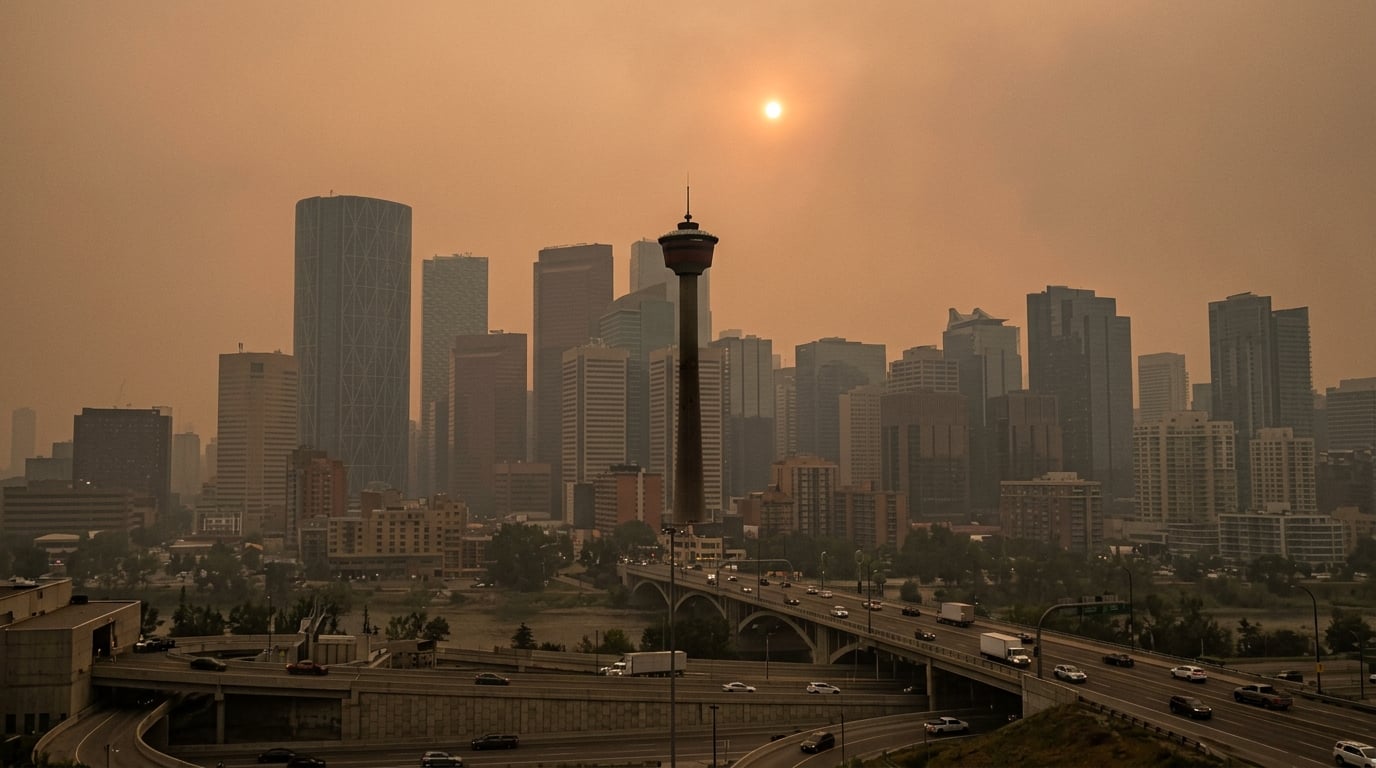
Smoke drifting south from wildfires burning in northern Alberta, the Northwest Territories, and B.C. has pushed Calgary's air quality to some of the worst readings of the summer. Environment and Climate Change Canada issued an Air Quality Warning this week as the city's AQHI climbed into the high and very-high risk categories, with values reported as high as 9 and briefly over 10 — the top of the scale. Environment Canada has been clear that conditions here can shift fast: readings can change significantly within a single day and even between neighbourhoods, so the number you see at 8 a.m. may not hold by noon.
That volatility is exactly why a fixed rule like "never go outside when it's smoky" isn't that useful in practice. What actually matters is checking the current number before you leave the house, not the forecast from the night before.
What the AQHI Number Actually Means
The Air Quality Health Index (AQHI) is the scale Environment Canada, Alberta Environment and Protected Areas, and Alberta Health Services use to communicate health risk from air pollution, including wildfire smoke. It runs from 1 to 10+, grouped into four bands:
The AQHI itself is built around human health outcomes — it doesn't publish a dog-specific version. But since dogs breathe faster than we do relative to their size and take in proportionally more of whatever is in the air, veterinary guidance generally treats "high risk" days for dogs the same way the AQHI treats its at-risk human population: reduce or skip strenuous outdoor time.
You can check Calgary's live AQHI reading and forecast directly at Environment Canada's AQHI page for Calgary, and see where the smoke itself is expected to move over the next 48 hours at FireSmoke.ca's BlueSky Canada smoke forecast.
How Wildfire Smoke Affects Dogs
Wildfire smoke is made up of fine particulate matter (PM2.5) small enough to reach deep into the lungs. Veterinarians describe its effects on dogs as similar to what it does to people: irritated eyes and airways, inflamed lungs, and worsened symptoms in animals with existing heart or lung conditions. One veterinary estimate cited by the AKC is that a full day of smoke-filled air is roughly comparable to a person smoking seven cigarettes.
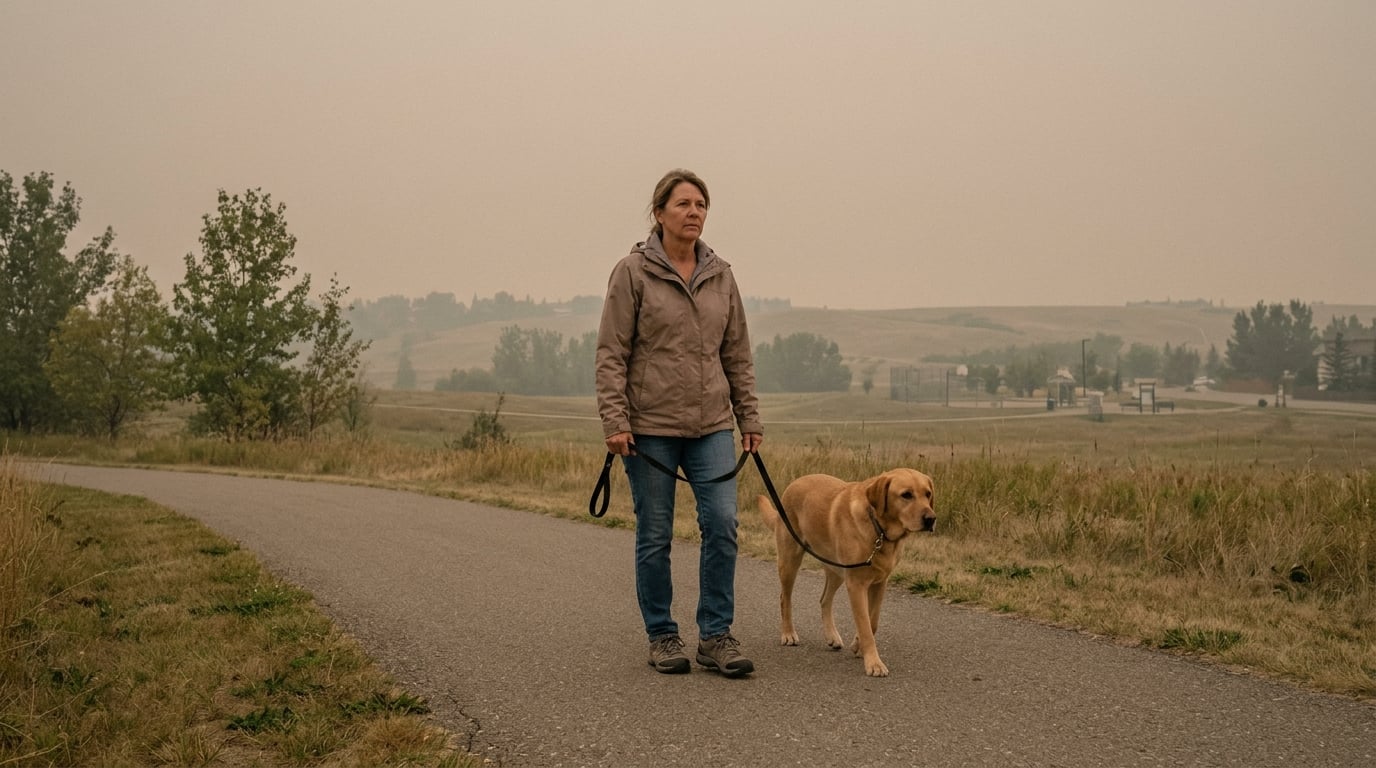
Watch for these signs of smoke exposure, especially after time outside on a high-AQHI day:
Puppies, senior dogs, and brachycephalic (flat-faced) breeds like Bulldogs, Pugs, and Boston Terriers are at higher risk, as are dogs with pre-existing heart, lung, or airway conditions. Cornell's veterinary college also notes that dust or pet masks aren't a reliable protection option for dogs the way an N95 can be for a person — the fit simply doesn't work on a dog's face, so the better strategy is limiting exposure time rather than trying to filter it. If your dog shows any of the more serious symptoms above, the AVMA's wildfire smoke guidance for pet owners and Cornell's canine air quality guide are both good places to check next steps, but persistent symptoms warrant a call to your vet.
Which Calgary Dog Parks Are More Exposed
Regional wildfire smoke like this week's event blankets the whole city fairly evenly once it's mixed through the day — there's no neighbourhood in Calgary that's simply immune. But there is a real, well-documented atmospheric pattern worth knowing about: overnight and in the early morning, cooler air can settle into river valleys and low-lying terrain and get trapped there by a temperature inversion, holding smoke close to the ground until the sun warms things up and mixes the air out. This is the same effect that traps winter smog in mountain valley cities, and it applies to smoke too.
What that means in practical terms for Calgary:
The takeaway isn't that one specific park is "safe" and another isn't — on a city-wide advisory day like this one, the AQHI reading applies everywhere. It's more that if you have a choice of when to go, a shaded river-valley walk in the late morning or afternoon (after the inversion has broken up) tends to beat an exposed hilltop walk in either full morning haze or afternoon heat.
When It's Actually Fine to Go
Not every hazy-looking day is a high-risk day, and it's easy to over-restrict based on how the sky looks rather than what the actual reading says. As a general guide, once the AQHI is back down in the 1–3 range:
At AQHI 4–6, healthy adult dogs can usually still go for a walk — just favour a shorter, slower loop over an off-leash sprint session, and skip it if your dog has a known heart, lung, or airway condition.
When to Skip the Park Entirely
At AQHI 7 and above — where Calgary has been sitting for parts of this week — veterinary guidance across the board (AVMA, Cornell, AKC) lines up on the same points:
If your dog has a pre-existing heart or lung condition, is a puppy, a senior, or a brachycephalic breed, it's worth treating the 4–6 range with the same caution as 7+.
A Good Day for an Indoor Park Instead
A high-AQHI day is exactly when Calgary's indoor dog park options earn their keep. Petfinity in the city's southwest is the largest walk-in option — 15,000 square feet of climate-controlled indoor play space with a separate area for small or reactive dogs, open to drop-ins rather than requiring daycare enrollment. It's a genuinely useful option on a day like this: your dog still gets to run around and burn energy without breathing smoke-laden air for an hour.
For the full rundown of every walk-in indoor dog park, private rental space, and how they differ from daycare facilities, see our complete Indoor Dog Parks Calgary guide.
Quick Reference Checklist
*Air quality conditions referenced in this article reflect Calgary's wildfire smoke event of July 2026 and can change quickly. Always check the live AQHI reading before heading out, and talk to your veterinarian if your dog shows any signs of respiratory distress.*